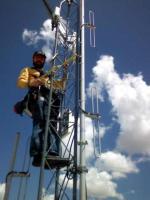
Lessons from Laramie: Broadband Innovation on the Wireless Frontier
Brett Glass
Tuesday, December 22, 12:30 pm
Berkman Center, 23 Everett Street, second floor
RSVP required for those attending in person (rsvp@cyber.harvard.edu)
This event will be webcast live at 12:30 pm ET and archived on our site shortly after.
18 years ago, Brett Glass -- an electrical engineer, inventor, and technology columnist -- established LARIAT, the first terrestrial wireless Internet service provider (WISP), in Laramie, Wyoming. He did it, initially, not as an entrepreneurial venture (the network started as a nonprofit co-op) but to solve a problem for his community: Laramie had no high speed Internet other than that on the University of Wyoming campus (which at the time had just upgraded from a few T1 lines to an almost unimaginably fast DS-3). The network made innovative use of early spread spectrum digital radio technology -- the great granddaddy of Wi-Fi -- to provide high speed Internet years before DSL or cable modem service was available, and continues to reach areas where these services do not go.
LARIAT and other WISPs -- most of them small, local businesses -- have fought difficult economics, the anticompetitive practices of incumbent telecommunications providers, and an adverse regulatory environment to build out the Internet to places where cable and telephone companies will likely never venture. They now serve approximately a million accounts and an estimated 3 to 4 million people, yet have remained below many policy makers' radar.
What's it like to roll up your sleeves and roll out high speed connectivity to underserved and unserved areas with, literally, one's bare hands? What are the logistics? What are the challenges? How can policy decisions in faraway Washington, DC -- perhaps influenced by scholarship at institutions such as Harvard -- help or hurt WISPs' efforts to boldly go where other network providers cannot or will not? Join us for an animated discussion of broadband technology, competition, and the effects of regulation on Internet innovation and deployment.
About Brett
Brett Glass is an electrical engineer, consultant, author, inventor, and small business owner residing in Laramie, Wyoming. With a BSEE from Case Institute of Technology and an MSEE from Stanford, Brett has designed numerous chips, software products and embedded systems and has authored more than 2,000 technology-related articles, columns, and books. He established LARIAT, the world's first WISP (terrestrial wireless Internet service provider), in 1992; today, LARIAT brings connectivity to hundreds of square miles not covered by any other terrestrial high speed Internet service. When he is not writing software, managing networks, or advocating wireless connectivity, he enjoys playing the Ashbory bass, refurbishing old houses, drinking good coffee, and cooking and eating exotic ethnic foods.